The short answer
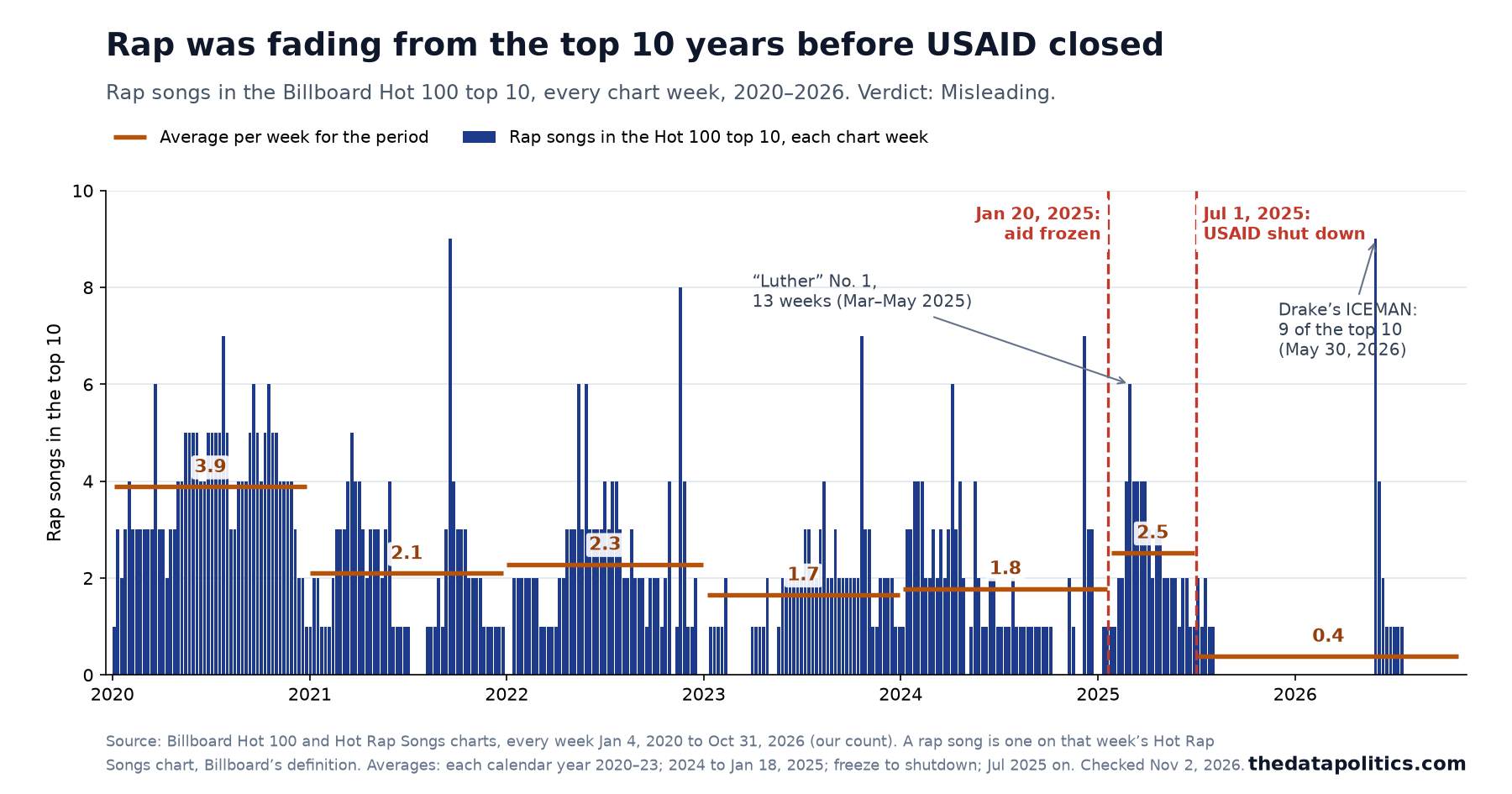
Two things in the post are true. In October 2025, rap was missing from the Billboard top 40 for the first time since 1990. And USAID really did pay rappers abroad to stir dissent: AP exposed a covert program in Cuba in 2014. But nothing supports the cause she gives, and the timing cuts against it. Rap’s presence in the top 10 had already roughly halved between 2020 and 2021. In the five months after the aid freeze, rap did better than in 2024, with “Luther” at No. 1 for 13 weeks. And the “zero” wasn’t zero: in May 2026, Drake held 9 of the top 10.
The slump Chen points to is real, and it did deepen after USAID shut down. From August 2025 to May 2026, rap had no song in the top 10 for 42 straight weeks, and it has had none since late July 2026. USAID could in theory be part of the story, but no data or record shows it. The evidence that exists points to rule changes, release schedules and a country boom.
Row by row
| The claim | What the data shows | Verdict |
|---|---|---|
| “For the first time since 1990 no rap songs in the Billboard top 40.” | True for the Hot 100 dated Oct 25, 2025, the first rap-free top 40 since Feb 1990 (Billboard). Billboard said a new rule had just pushed “Luther,” then No. 38, off the chart for being too old, and all 12 songs from Taylor Swift’s new album sat in the top 40. The first gap lasted two charts. Megan Thee Stallion ended it on Nov 8 (Billboard). By our count, rap missed the top 40 on five more charts through Jan 3, 2026, three of them in December, when Christmas songs crowd the chart. It has been in the top 40 every week since Jan 10, 2026. On the chart that was current when she posted (Aug 1, 2026), it had 6 songs there (Hot 100). | Claim right It happened, and it was historic. But it was nine months old when she posted, and rap was back in the top 40. |
| “Average rap songs in the top 10 with USAID 4 per week.” | We counted rap songs in the Hot 100 top 10 for every chart week since 2020. A rap song is one on that week’s Hot Rap Songs chart, which is Billboard’s own test. The average per week was 3.9 in 2020, then 2.1 in 2021, 2.3 in 2022, 1.7 in 2023 and 1.8 in 2024 through mid-January 2025. Over the five years before the aid freeze it was 2.3 (our weekly data). We could not find the source of her 4. | Misleading Four a week is roughly right for 2020, rap’s peak year. In the four years after that, the average was about half that. |
| “Without USAID zero.” | Between the Jan 20, 2025 aid freeze (executive order) and USAID’s shutdown on Jul 1 (NPR), rap averaged 2.5 songs a week in the top 10, more than in 2024, and was there on all 23 charts. Kendrick Lamar and SZA’s “Luther” spent 13 weeks at No. 1, Mar 1 to May 24, 2025. After the shutdown came a real drought: no rap in the top 10 on 42 straight charts, Aug 9, 2025 to May 23, 2026. Then on the May 30, 2026 chart Drake held 9 of the top 10 (Nos. 1–4 and 6–10) (Billboard, Hot 100). His “Janice STFU” stayed in the top 10 until the Jul 18 chart. From the shutdown to her post, the average was 0.5 a week. | Misleading Close to true for most of the year after the shutdown: 42 straight weeks with no rap in the top 10. But not zero, because Drake’s album broke the drought two months before she posted, and not right after the freeze, when rap gained. |
| “Rap is dead basically because USAID stopped funding it.” | Timing: the biggest drop came between 2020 and 2021, from 3.9 to 2.1 a week, four years before USAID closed. Rap’s share of all US listening peaked near 30% in 2020 and was 24% in 2025 (Billboard, citing Luminate). In the first half of 2026, R&B/hip-hop still drew “approximately 1 in every 4” US audio streams, more than any other genre (Luminate). Hip-hop’s share of new top-10 hits rose to 21% in the first half of 2026, from 19% in 2025 (Billboard / Hit Songs Deconstructed). Other explanations: in Oct 2025, Billboard pointed to its new chart rule and to the biggest rappers not having new albums out. When Drake released one, rap took the top four spots. | No evidence It could be true, but nothing supports it. No record shows USAID money behind US rap. The slide started years before the aid cuts, and rap rose right after the freeze. The deeper slump after the shutdown is a match in timing, not proof of a cause. |
| “USAID was openly funding rap in Bangladesh and Cuba to create street protests and political dissent.” | Cuba: true, but it was secret, not open. AP found that a USAID contractor, Creative Associates International, sent a promoter to Havana in 2009 to recruit rappers, including Los Aldeanos, to “spark a youth movement against the government.” The contractor hid the work behind a front company in Panama (AP, AP, AP timeline, Guardian). Bangladesh: a US agency did it, but not USAID. The International Republican Institute paid Bangladeshi rapper Towfique Ahmed for two music videos in 2020 under a State Department award (S-LMAQM-18-CA-2011). Its final report says one song encouraged democracy work “including protests and street movements,” and the other was designed to “build up disappointment and even dissent to government” (IRI final report). | Partly right Her strongest point. The US government did pay foreign rappers to stir dissent. But the Cuba program was covert, and the Bangladesh money came from the State Department. |
| “Why would they do it overseas but not here?” | USAID was the US foreign-aid agency; the executive order that froze it covered “foreign development assistance” (White House). In the AP reporting, the IRI report and the Billboard coverage of rap’s slump, we found no grant, contract or report showing USAID paying US artists, labels or streams. None of the sources links rap’s US chart run to USAID money. | No evidence A question isn’t evidence. The record shows the programs abroad, not any at home. |
| Where some of rap went | Country took over the top of the chart. Ella Langley’s “Choosin’ Texas” has a record 25 weeks at No. 1 (Billboard). Some rappers followed the audience: Houston rapper BigXthaPlug’s Aug 2025 album, made with Jelly Roll, Luke Combs, Shaboozey and Ella Langley, is country-trap (Billboard). Its “Hell at Night,” with Langley, still counts as a rap song on Billboard’s charts and was one of the highest-ranked during the October drought (Billboard). | Context Not a verdict on Chen. Part of rap’s audience moved toward country crossovers, not off the charts. |
Scorecard: right that rap left the top 40 in 2025 for the first time since 1990, and right that the US government paid foreign rappers to stir dissent. The “4 per week” is rap’s peak year presented as the norm. “Zero” was close to true for most of the year after the shutdown, but not when she posted it. The cause she gives may be possible, but nothing supports it.
The accurate version
“Rap has been losing chart ground since 2020, and in late 2025 it fell out of the top 40 for the first time since 1990. Country is having its biggest run in decades. Separately, USAID once ran a covert program to recruit Cuban rappers against the government, and the State Department paid for protest-minded rap videos in Bangladesh.” Every part of that can be checked, and the record backs it.
The takeaway
This post rests on two true facts: the US government has paid rappers abroad to stir up dissent, and rap really did slip off the American charts. It then adds a third claim, that one caused the other, and offers nothing to back it. The timing is the only link, and it is weaker than it looks. Rap’s slide began in 2021, years before any aid was cut. In the five months right after the freeze, rap was in the top 10 every week and at No. 1 for 13 of them. The slump did deepen after USAID shut down, and when the biggest rapper in the world released an album, he still took nine of the top ten spots. Could USAID money have propped up American rap? It is possible to imagine. But no grant, contract or report shows a dollar of it behind an American hit. Two true facts and a timeline don’t make a cause; it takes evidence, and so far there isn’t any.
Method and caveats
- What counts as rap. A song counts as rap in a given week if it appears on that week’s Billboard Hot Rap Songs chart (top 25). That is the definition Billboard used for its “no rap in the top 40” story. Songs are matched by title within the same chart week.
- The weekly count covers all 357 Hot 100 charts from Jan 4, 2020 to Oct 31, 2026, read from billboard.com’s chart archive on Nov 2, 2026. The weekly counts, with the rap titles in each top 10, are downloadable as a CSV.
- Periods. “Before the freeze” runs to the Jan 18, 2025 chart. “Freeze to shutdown” covers the Jan 25 to Jun 28, 2025 charts. “After the shutdown” starts with the Jul 5, 2025 chart. Her post went up on Jul 30, 2026, when the Aug 1, 2026 chart was current.
- Chart rule change. Billboard sped up its “recurrent” rule for the Oct 25, 2025 chart, which removes older songs as they fall. That makes any genre that depends on long-running hits look smaller in the top 40 than before.
- Genre share figures are from Luminate, which counts R&B and hip-hop together, and from Hit Songs Deconstructed, which counts each top-10 hit once by its main genre. Neither is the same as our weekly count.
- Bangladesh. The IRI report was published by The Grayzone. Its cover names the State Department and award S-LMAQM-18-CA-2011. We found no evidence that USAID funded that work.
- Not checked. The post includes a video. We have not reviewed it and rate only the text quoted above.
Sources
- The claim: @TheLaurenChen on X, Jul 30, 2026. Text quoted verbatim.
- Charts: Billboard Hot 100 and Hot Rap Songs, weekly archive (e.g. Oct 25, 2025, May 30, 2026, Aug 1, 2026); our weekly count.
- Billboard reporting: no rap in the top 40 (Oct 29, 2025); Megan Thee Stallion ends the gap (Nov 3, 2025); Drake’s 42 entries (May 26, 2026); top-10 trends, midyear 2026 (Jul 31, 2026); “Choosin’ Texas,” 25th week at No. 1 (Oct 26, 2026); BigXthaPlug’s country-trap album (Aug 2025).
- Listening share: Luminate 2026 Midyear Report (Jul 15, 2026).
- USAID: Executive order pausing foreign aid (Jan 20, 2025); NPR on the Jul 1, 2025 shutdown.
- Cuba: AP investigation (Dec 2014); AP, 5 things to know; AP timeline; The Guardian (Dec 11, 2014).
- Bangladesh: International Republican Institute, PAIRS Bangladesh final report to the State Department (program Mar 2019 to Dec 2020).
Data checked Nov 2, 2026. Only the quoted text is attributed to Chen.